
Office-to-Residential HVAC Nightmares: Why Your “Industrial Chic” Loft Breathes Like a Server Room
Our team has walked these conversions with anemometers, thermal cameras, and plumbers who still carry code books in their trucks. The verdict is consistent: converting commercial shells into homes is not adaptive reuse—it’s adaptive compromise. Buyers are paying a premium for exposed brick while inheriting systems that were never meant to keep a family comfortable at 2 a.m.
The Air Was Designed for 9-to-5, Not 24/7 Living
Commercial offices are engineered for predictable occupancy and schedules. Air changes per hour (ACH) spike at 8:30 a.m., taper by 6 p.m., and assume people go home. Residential comfort needs the opposite: low noise, constant modulation, and individualized control.
What we measured on-site
- VAV boxes throttled for daytime loads, not overnight stability.
- Static pressure tuned for long trunk lines feeding open floors, not short runs to bedrooms.
- Return air paths that rely on ceiling plenums—fine for cubicles, a mess for sleeping spaces.
Why this matters
- Bedrooms starve for air while kitchens get blasted.
- Thermostats lie because they’re sampling the wrong zone.
- Night setbacks save energy in offices; they wreck sleep at home.
Autiar Takeaway
Marketing calls this “loft airflow.” Our measurements show it’s a mismatch: office-grade distribution paired with residential expectations. The result is hot bedrooms, cold living rooms, and fans masking design errors.
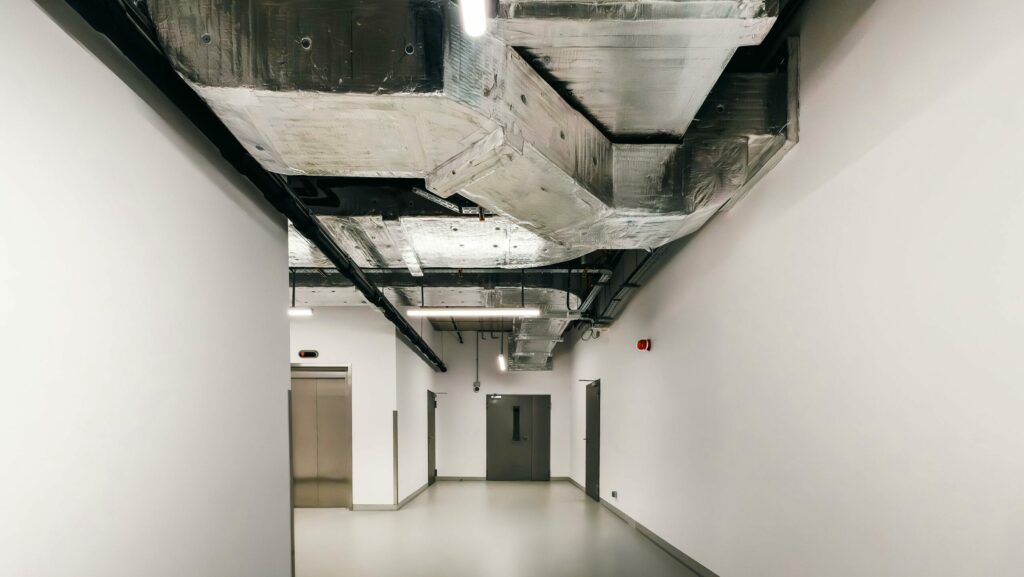
Ductwork Geometry: When Exposed Means Exposed Problems
Exposed spiral duct looks honest. It’s also loud, leaky, and unforgiving.
Inside-baseball details
- Spiral duct leakage often exceeds SMACNA Class 3 unless sealed obsessively. Developers rarely pay for that.
- Elbow radius in tight retrofits increases turbulence. We logged pressure drops 18–25% higher than spec.
- No lined ducts because “aesthetics,” which means higher NC ratings at night.
Compare this to two standards:
- Pre-war residential retrofits: smaller, lined ducts, slower velocities. Quiet, boring, effective.
- Modern condo towers: fan-powered terminal units with lined plenums and short runs. Costly, but controllable.
Autiar Takeaway
Exposed duct is a styling choice that transfers acoustic and airflow risk to the buyer. You’re paying for honesty and getting noise.
Central Plants, Individual Pain
Many conversions keep the central chilled water and hot water plant. It pencils on CapEx; it punishes on OpEx.
What breaks
- Seasonal changeover lags. Spring heat waves meet winter valves.
- Metering ambiguity: BTU meters are rare; allocation formulas are common.
- Control latency: BAS logic updates in minutes, not seconds. We clocked 90–180 seconds to respond to a load change—fine for offices, maddening at home.
Competitors and alternatives:
- VRF (Variable Refrigerant Flow) in purpose-built residential: fast response, room-level control, higher upfront cost.
- Water-source heat pumps per unit: still central, but at least you own your compressor.
Autiar Takeaway
Central plants socialize comfort. You inherit your neighbor’s cooking habits and the building engineer’s priorities.
Plumbing: The Vertical Tax Nobody Mentions
Offices don’t shower at midnight. Residential buildings do. The plumbing stack doesn’t care about vibes.
Observed failures
- Pipe sizing assumes short, synchronized use. Add tubs and washing machines and watch velocities spike.
- Long horizontal runs to avoid slab cuts lead to slow drains and biofilm.
- Hot water recirculation tuned for office pantries, not showers. Wait times hit two minutes in some units.
Compare to:
- Ground-up apartments: shorter runs, dedicated risers, predictable demand.
- Hotel conversions done right: aggressive recirc, oversized drains, acoustic isolation. Expensive, rare.
Autiar Takeaway
The plumbing works—until everyone uses it like a home. Then gravity sends you the bill.
Fire and Fresh Air: Codes Collide Quietly
Life safety retrofits dominate budgets, so ventilation becomes the silent loser.
Technical friction
- Pressurization requirements fight with residential exhaust needs.
- Make-up air is undersized because kitchens weren’t kitchens before.
- Operable windows are added for sales, then limited by smoke control logic.
Autiar Takeaway
Codes don’t guarantee comfort. They guarantee survival. Everything else is value-engineered.
Maintenance Reality: Who Owns the Headaches?
Office systems assume a facilities team. Homes assume an app and a help line.
What owners face
- Proprietary BAS with login gates.
- Deferred maintenance masked by a fresh CO.
- Specialized parts with lead times measured in weeks.
Autiar Takeaway
You didn’t buy a home. You bought a service contract you can’t renegotiate.
The Autiar Verdict
Action, Hold, or Pass—by persona
The Budget-Conscious
- Recommendation: Pass
- You’re paying a premium for finishes while underwriting future mechanical fixes. Ground-up mid-rise beats this on lifetime cost.
The Power-User
- Recommendation: Hold
- If you can audit drawings, budget for duct sealing, add room-level controls, and push the HOA, you can tame it. Most won’t.
The Future-Proofer
- Recommendation: Pass
- Decarbonization favors electrified, unit-level systems. Central plants and legacy ducts age poorly.
Frequently Asked Questions
Is upgrading to VRF feasible in a converted building?
Sometimes. It requires shaft space, condenser placement, and electrical capacity that many conversions lack. Expect structural and HOA friction.
Can better filters fix the air issues?
No. MERV ratings address particulates, not distribution, noise, or control latency. Filters don’t change geometry.
Are all office-to-residential projects bad?
No. The good ones overspend on mechanicals, hide ducts, add metering, and accept lower ceiling heights. They are the exception—and priced accordingly.
If you’re shopping the look, price the lungs and veins first. Our data says that’s where the regret hides.